Hardware Recommendations for LLM Fine-Tuning: The 2026 Guide
Optimizing VRAM, Interconnects, and Compute for High-Performance Training

Caspar Lehmkühler
January 28, 2026 · Head of Product at Lyceum Technologies

The landscape of LLM fine-tuning has shifted from 'can we run it' to 'how fast can we converge.' As models like Llama 4 push parameter counts and context windows further, the hardware bottleneck has moved beyond raw TFLOPS to VRAM capacity and interconnect bandwidth. Engineers often underestimate the memory overhead of optimizer states and gradients, leading to frequent OOM errors on consumer-grade or poorly orchestrated cloud hardware. At Lyceum Technology, we see teams losing weeks to infrastructure debugging that could be solved by matching the right silicon to the specific fine-tuning method. This article provides a technical deep dive into the hardware requirements for full fine-tuning, LoRA, and quantized workflows in the current 2026 ecosystem.
The VRAM Equation: Calculating Your Memory Budget

VRAM is the primary constraint in any fine-tuning job. To avoid the dreaded Out-of-Memory (OOM) error, you must account for more than just the model weights. In a standard 16-bit (BF16) full fine-tuning scenario, the memory footprint is a function of weights, gradients, and optimizer states.
According to industry benchmarks, the math for a standard AdamW optimizer looks like this:
- Model Weights: 2 bytes per parameter.
- Gradients: 2 bytes per parameter.
- Optimizer States: 12 bytes per parameter (for AdamW).
- Activations: Variable, scaling with batch size and sequence length.
For a 70B parameter model, full fine-tuning requires approximately 1.12 TB of VRAM before even considering activations. This necessitates a multi-node cluster of H100s or a high-density B200 environment. If you are using Parameter-Efficient Fine-Tuning (PEFT) like LoRA, the gradient and optimizer state requirements drop significantly because you are only updating a small fraction of the weights. However, the base model still needs to be loaded into memory, making 80GB GPUs the bare minimum for serious 70B+ model work.
GPU Selection: B200 vs. H100 vs. L40S
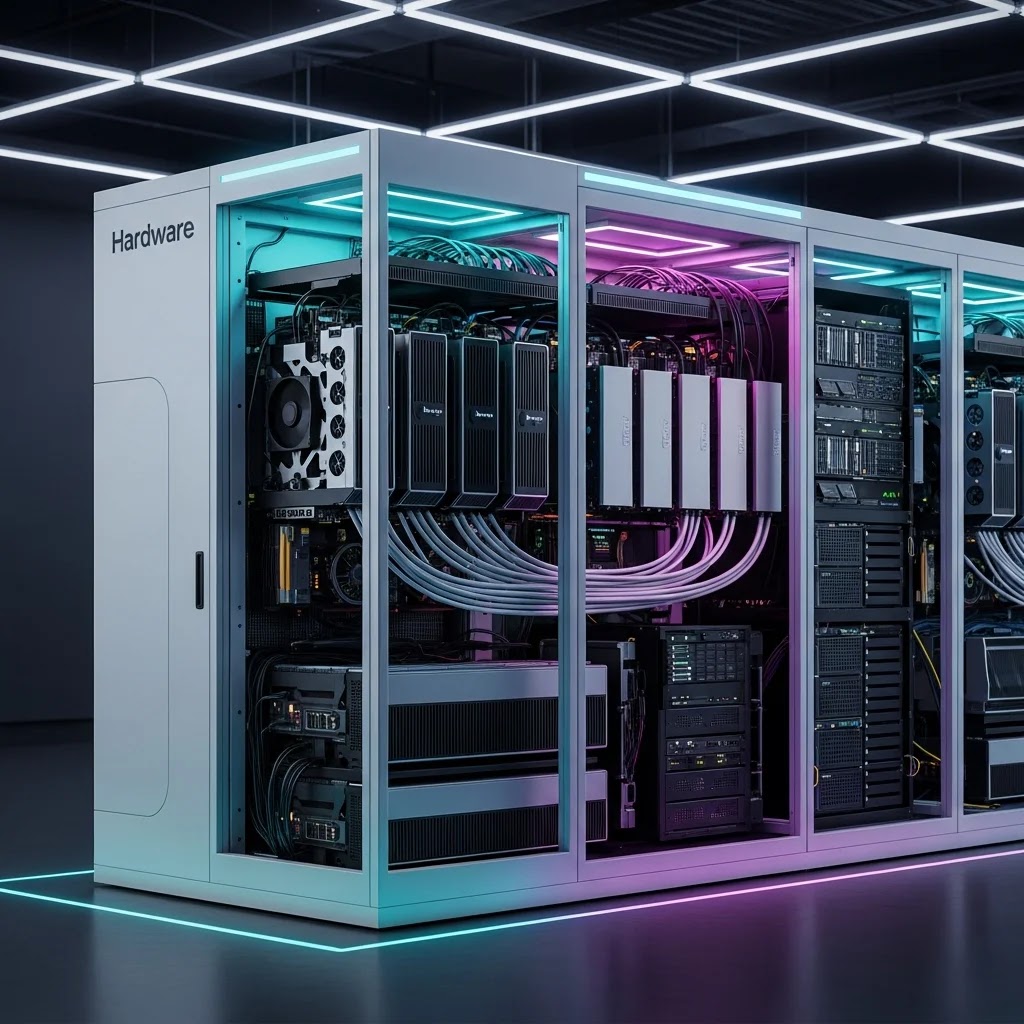
In 2026, the choice of GPU defines your training wall-clock time and total cost of ownership. While the H100 remains a reliable workhorse, the Blackwell-based B200 has redefined the performance ceiling for large-scale training.
The B200 offers 192GB of HBM3e memory, which is a 2.4x increase over the H100's 80GB. This extra headroom allows for larger batch sizes and longer context windows without resorting to complex memory-saving techniques that slow down throughput. A 2025 report from TensorPool indicates that while B200 instances carry a higher hourly premium, they often result in a 50% lower total training cost for models exceeding 150B parameters due to their superior speed and reduced need for massive multi-node scaling.
For teams focused on LoRA or smaller 8B to 30B models, the L40S or H100 are often more than sufficient. The L40S is particularly cost-effective for single-node tasks but lacks the NVLink interconnects required for efficient multi-GPU scaling in full fine-tuning scenarios. If your roadmap includes scaling beyond a single machine, the H100 or B200 are non-negotiable.
The Interconnect Bottleneck: Why NVLink is Critical
Raw compute power is useless if your GPUs are waiting for data. In distributed fine-tuning, the interconnect between GPUs is frequently the silent killer of performance. When training across multiple GPUs, the system must constantly synchronize gradients (All-Reduce operations). If this happens over standard PCIe lanes, the communication overhead can consume up to 70% of the total training time.
NVIDIA's NVLink technology provides a dedicated, high-bandwidth path for GPU-to-GPU communication. The fifth-generation NVLink on B200 systems delivers 1.8 TB/s of bidirectional bandwidth, doubling the capacity of the H100's NVLink 4.0. For AI engineers, this means near-linear scaling: doubling your GPU count actually doubles your training speed, rather than hitting a diminishing return wall caused by PCIe bottlenecks.
When selecting a cloud provider or building a cluster, verify the topology. A 'sovereign' infrastructure like Lyceum Cloud ensures that GPUs are interconnected via a non-blocking fabric, preventing the noisy neighbor issues and latency spikes common in generic hyperscaler environments.
Quantization and Memory Optimization Strategies
If your budget doesn't allow for a massive B200 cluster, software optimizations can bridge the gap. Techniques like QLoRA (Quantized LoRA) allow you to fine-tune 70B models on a single 80GB GPU by quantizing the base model to 4-bit while keeping the adapter weights in higher precision.
Common mistakes in memory optimization include:
- Ignoring Sequence Length: Doubling your context window from 4k to 8k tokens quadruples the memory required for self-attention activations.
- Over-reliance on CPU Offloading: While tools like DeepSpeed can offload optimizer states to system RAM, the latency penalty is massive. It is almost always better to use a more efficient GPU or a smaller model.
- Static Batch Sizes: Using fixed batch sizes instead of dynamic orchestration leads to underutilized VRAM.
Libraries like Unsloth have gained traction in 2025 and 2026 for providing up to 2x faster training and 60% less VRAM usage by optimizing the underlying kernels. Combining these libraries with high-performance hardware like the H200 (141GB VRAM) allows researchers to push the boundaries of what is possible on a single node.
Sovereign Infrastructure and Orchestration
The final layer of the hardware stack is the orchestration. Even the best B200 cluster is inefficient if the deployment process is manual and error-prone. Lyceum Technology provides an AI-enabled orchestration layer that automates hardware selection based on your model's specific requirements. By analyzing the parameter count and desired training method, our platform selects the optimal GPU configuration to eliminate OOM errors before they happen.
Sovereignty is also a technical requirement, not just a legal one. For deep-tech and biotech firms, keeping data within a European sovereign cloud ensures that sensitive training sets are never exposed to external jurisdictions. This control extends to the hardware level, where dedicated access to B200 and H100 clusters ensures predictable performance without the variability of shared public cloud resources.