Sovereign Cloud ML Training in Germany: The Technical Blueprint
Balancing B200 performance with EU AI Act compliance in 2026

Magnus Grünewald
February 2, 2026 · CEO at Lyceum Technologies
The landscape for AI development in Germany has fundamentally changed as of January 2026. With the EU AI Act now fully enforceable, the 'move fast and break things' era of training on offshore hyperscalers has hit a regulatory wall. For CTOs and ML leads, the priority has shifted toward building on sovereign infrastructure that guarantees data residency while providing the raw compute power of NVIDIA B200 and H100 clusters. However, sovereignty often comes with a technical tax: fragmented hardware access and manual DevOps overhead. We built Lyceum to bridge this gap, offering a peer-to-peer orchestration layer that treats sovereign German data centers as a single, high-performance compute fabric.
The Sovereignty Mandate: Why 2026 is the Turning Point
As of early 2026, the European AI landscape is defined by the full applicability of the EU AI Act. According to a 2025 report from Scalevise, any provider of a general-purpose AI model is now required to publish a public summary of their training data and respect strict copyright opt-outs. This isn't just a legal hurdle; it is a technical requirement that dictates where your data lives and how it is processed.
For deep-tech and biotech startups, the risk of training on non-sovereign clouds is no longer just a matter of latency. It is a matter of legal viability. If your training data or model weights are subject to the US CLOUD Act, you may find yourself locked out of the European public sector and highly regulated industries like healthcare or finance. The German sovereign cloud market is projected to reach over $13 billion in 2026, driven by this exact need for localized control.
- Data Residency: Ensuring that training datasets never leave German or Swiss borders.
- Operational Sovereignty: Maintaining a control plane that is independent of non-EU entities.
- Technical Sovereignty: Having the ability to migrate workloads without prohibitive egress fees or proprietary lock-in.
At Lyceum, we see sovereignty as a performance feature. When your compute is local, you reduce the 'compliance latency' that slows down deployment cycles in highly regulated sectors.
Hardware Realities: B200 vs H100 in German Data Centers
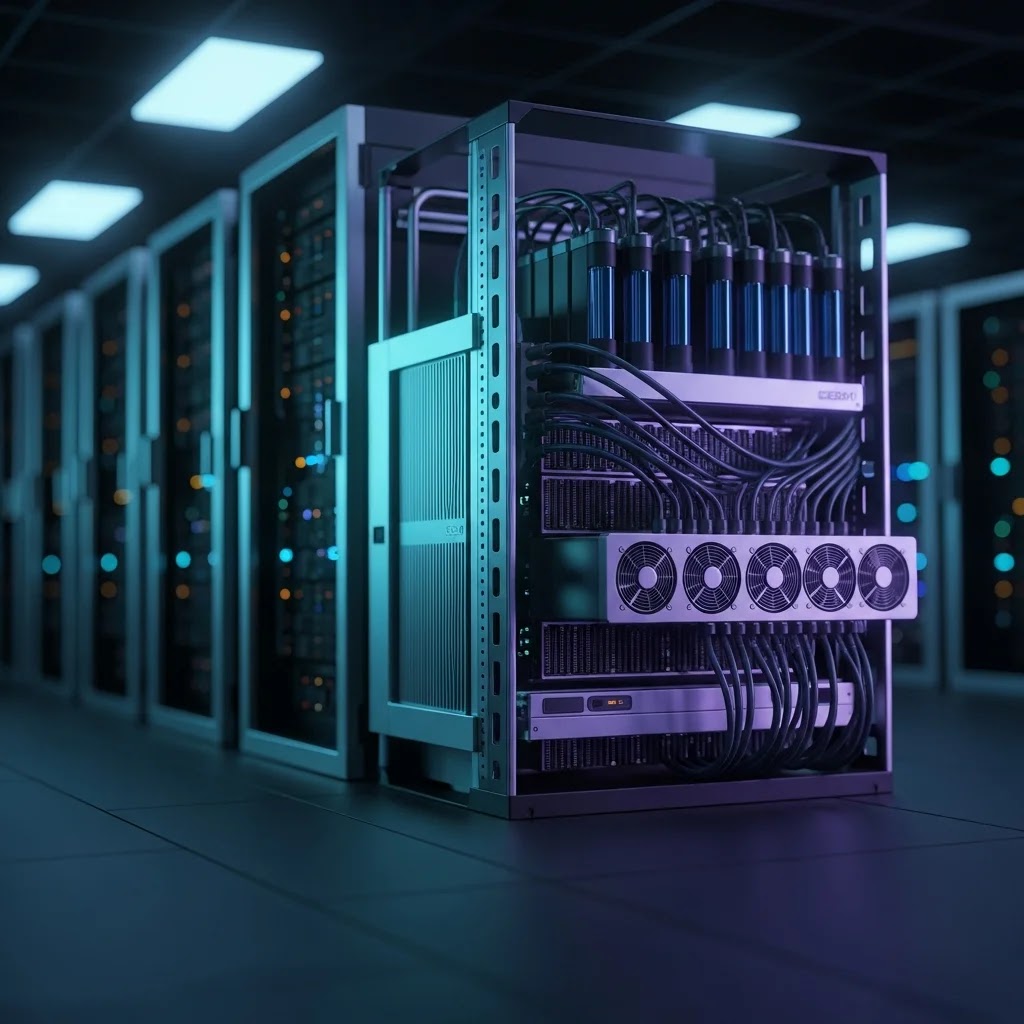
The hardware landscape in 2026 is dominated by the transition from Hopper to Blackwell. While the H100 remains a workhorse for fine-tuning and smaller models, the NVIDIA B200 has become the standard for large-scale training. According to NVIDIA's technical benchmarks, the B200 delivers roughly 2.2 to 2.5 times the training performance of the H100, largely due to its 192GB of HBM3e memory and 8 TB/s of bandwidth.
For researchers, the jump from 80GB to 192GB of VRAM is transformative. It allows for significantly larger micro-batches, which directly translates to faster convergence and reduced training costs. However, securing these chips within Germany requires more than just a credit card. It requires an orchestration layer that can handle the thermal and power demands of Blackwell clusters, which can pull up to 1,000W per GPU.
Lyceum Technology provides direct access to these sovereign B200 and H100 clusters through a unified CLI. We handle the hardware selection and optimization, ensuring that your training jobs are matched with the most efficient interconnects, whether that is NVLink 5 for multi-node training or optimized InfiniBand setups.
Solving the Orchestration Tax with Protocol3
A common mistake in ML infrastructure is focusing solely on GPU count while ignoring the orchestration layer. A 2025 Fujitsu report highlighted a staggering reality: over 75% of organizations report GPU utilization below 70% at peak load. In many research labs, this number is even lower, often hovering around 40% due to inefficient job scheduling and Out-of-Memory (OOM) errors.
We developed Protocol3 to solve this 'orchestration tax.' Protocol3 is our underlying protocol that manages the communication between the developer's terminal and the sovereign GPU hardware. It acts as an intelligent buffer that optimizes hardware selection based on your model's specific requirements. If you are training a 70B parameter model, Protocol3 ensures the memory allocation is striped across the cluster to eliminate OOM errors before they happen.
By doubling GPU utilization for our users, we effectively halve the cost of training. Instead of paying for idle silicon while your data is being pre-processed or your checkpoints are being saved, Lyceum's orchestration layer ensures that the GPUs are constantly saturated with compute tasks.
The Economics of Sovereignty: Egress and Hidden Costs
One of the most significant advantages of using a sovereign German provider like Lyceum is the transparency of the cost model. Hyperscalers often lure teams with low hourly rates only to hit them with 'egress taxes' when it comes time to move model weights or large datasets. A 2025 study on cloud storage pricing noted that hidden fees like egress and API calls can inflate a monthly bill by over 40%.
In a sovereign setup, these costs are minimized. Because the data stays within the local network, egress fees are often non-existent or significantly lower. This is critical for AI-first startups that need to move terabytes of data between storage and compute nodes daily. We prioritize flat, predictable pricing that allows CTOs to forecast their burn rate without worrying about a surprise bill at the end of a training run.
Furthermore, the EU Data Act, which became effective in late 2025, aims to eliminate vendor lock-in by banning switching charges. By choosing a sovereign-first provider now, you are aligning your infrastructure with the future of European digital policy, ensuring that your models remain portable and your data remains yours.
Decision Framework: When to Choose Sovereign ML Training
Not every project requires a sovereign cloud, but for those that do, the choice is binary. If you are operating in any of the following scenarios, a sovereign German cluster is no longer optional:
- Biotech and Healthcare: When training on patient data that is protected by strict GDPR and local health data regulations.
- Government and Defense: When the model weights themselves are considered sensitive national assets.
- High-Stakes FinTech: When auditability and data residency are prerequisites for operating licenses.
If your team is spending more than $100,000 per month on public cloud compute, the shift to a sovereign provider often pays for itself through efficiency gains alone. At Lyceum, we don't just provide the GPUs; we provide the orchestration layer that makes them usable for researchers who don't want to spend their time debugging Slurm configurations or managing Kubernetes clusters.